My curiosity about how things move started early. In the 2013–2014 school year, it became a project we could build, take apart and improve. We began with a structure that could move, then added remote commands and a simple scanning system.
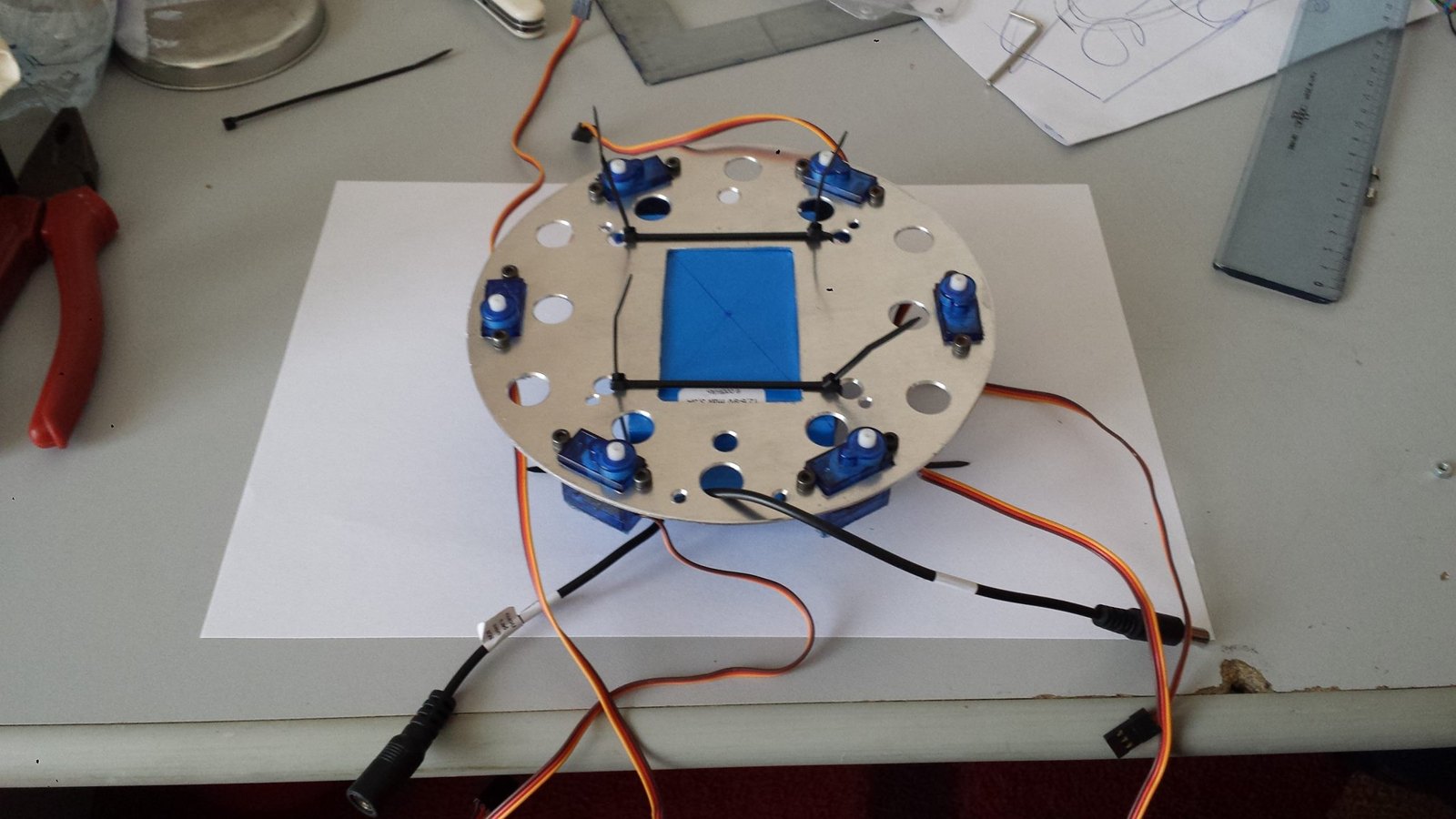
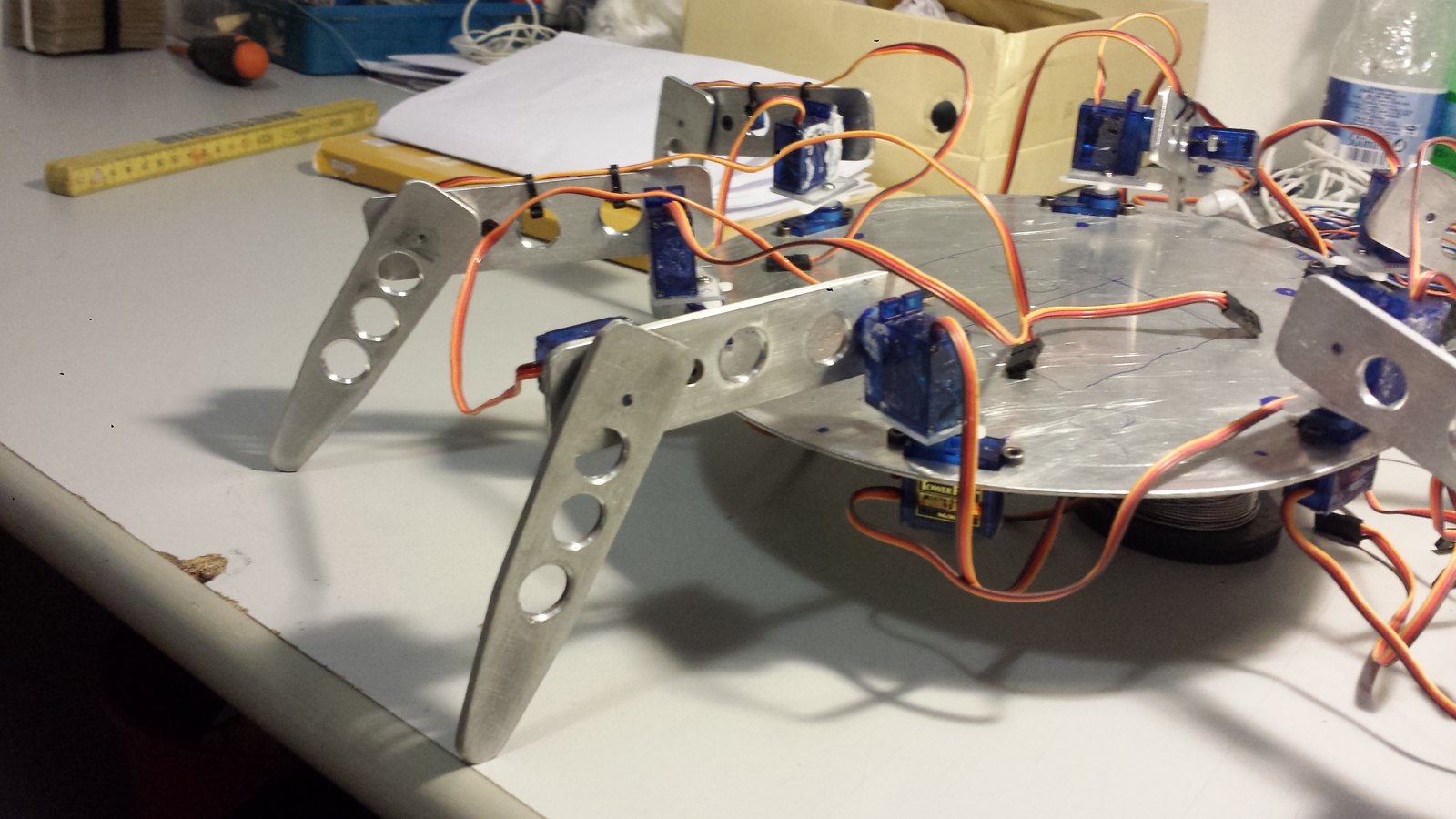
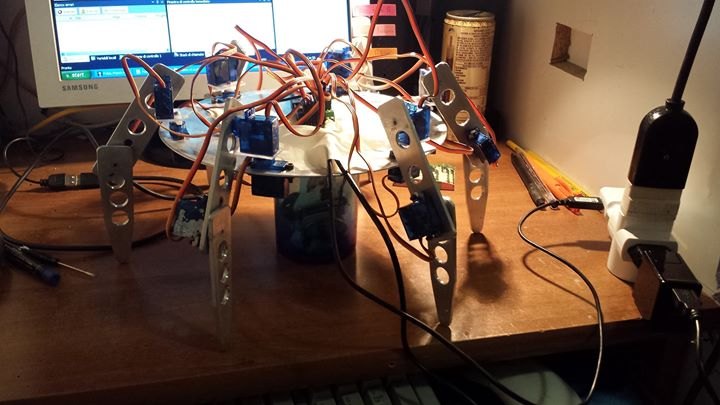
The archive records that process without hiding the rough edges: exposed wiring, handmade aluminium parts, changing assemblies and repeated tests. This was a school prototype, and its value was in what it taught us to connect.
What the robot could do.
Features of the complete project, developed together.
- Six-legged locomotion
- Eighteen leg servos, with commands for forward, backward and left/right movement.
- Body height and gestures
- Raise or lower the body, perform a greeting movement and release the commanded motor positions.
- Internet control
- A desktop interface exchanged movement commands through a database and displayed command state and errors.
- Bluetooth control
- A smartphone or tablet app supported device discovery, connection and touchscreen movement commands, with connection indication and logs.
- Servo configuration
- Parameterized movement sequences and adjustable offsets for actuator neutral positions.
- Distance acquisition
- A two-axis sensor mount, nonlinear distance conversion, an 8-bit ADC and I²C communication.
- 3D scanning and visualization
- Raster acquisition with buffered database storage, followed by a separate application reconstructing the sampled surface.
- Integrated operation
- An onboard application coordinated communication, movement and scanning with separate threads and selectable operating modes.
My part in the project.
My work focused on internet-based control, movement management, the distance sensor and its conversion algorithms, the choice of signal acquisition without an additional conditioning circuit, the 8-bit ADC and I²C communication, and the scan-acquisition program. The thesis index records this division of work. The robot was a shared project; Stefano also developed important electronics and software components.
Making it work
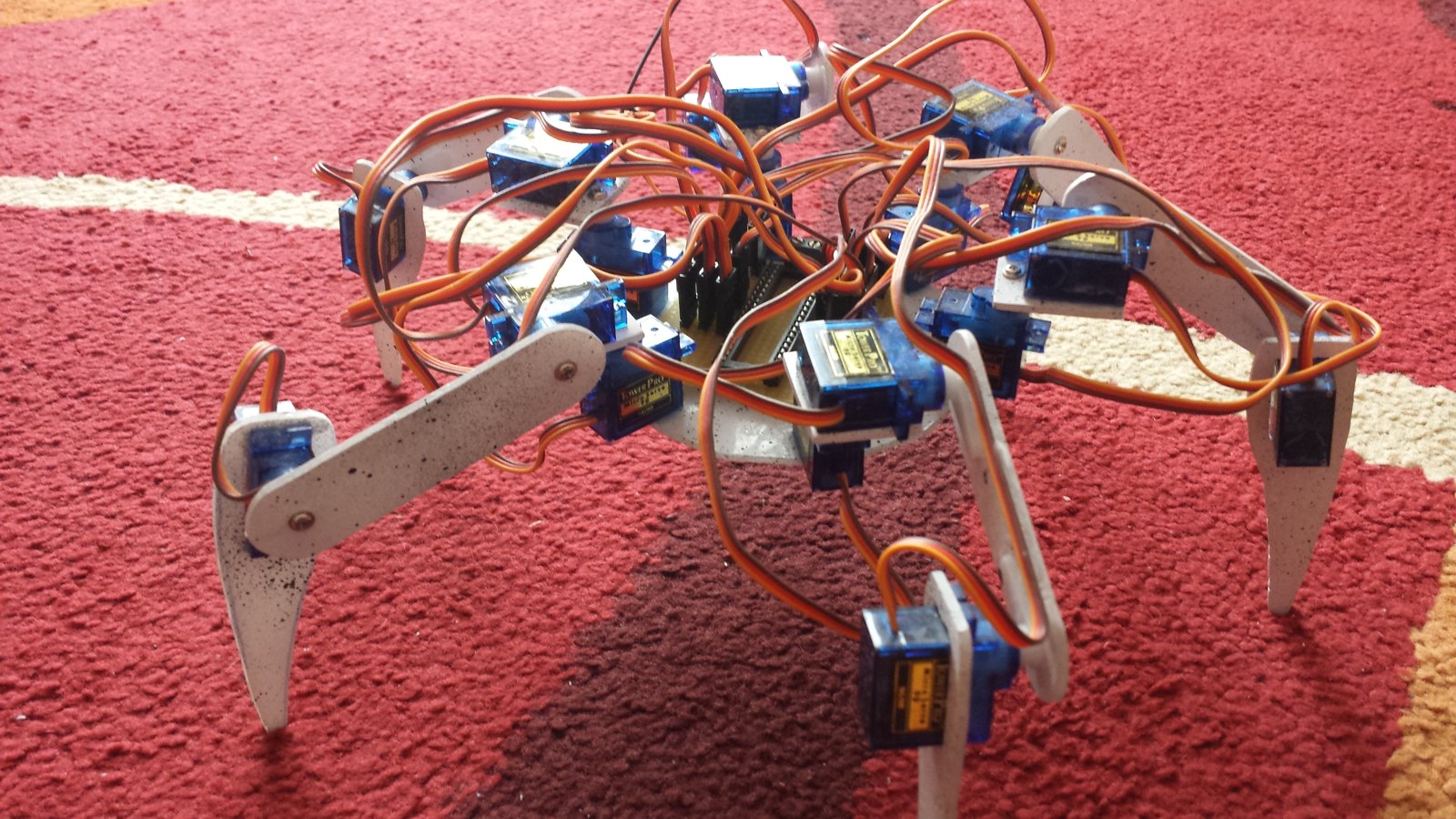
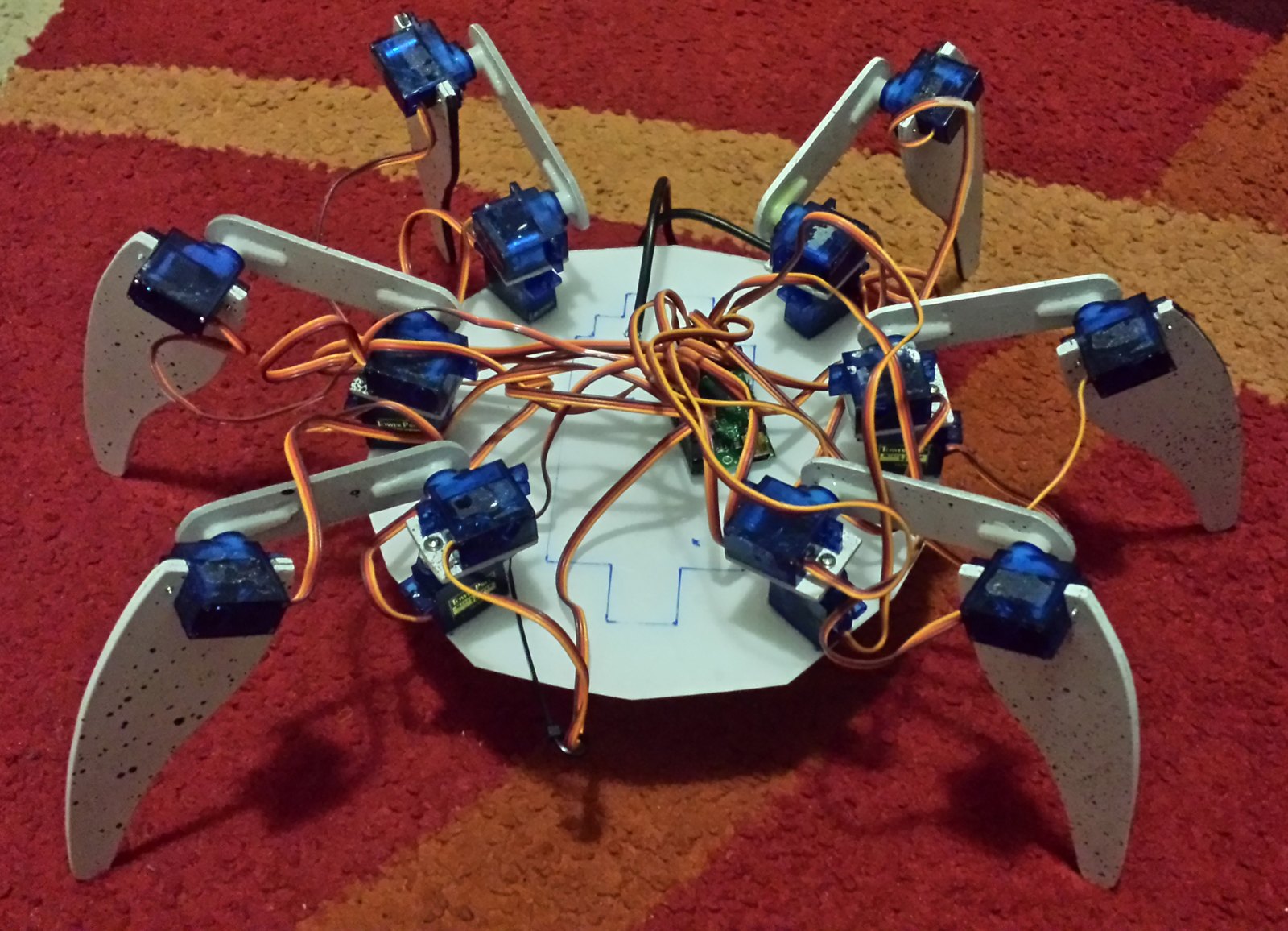
Early assemblies, an intermediate movement test and a changing mechanical structure.
01
Six legs, coordinated movements.
Each leg used three servo motors, giving eighteen actuators for locomotion. The software organized individual motor commands into leg movements and higher-level actions such as walking, raising the body and greeting. Adjustable offsets helped compensate for assembly and neutral-position differences. This was programmed coordination, with practical limits in torque and mechanical stiffness.
02
Two ways to control the robot.
Internet commands passed through a database and a C# desktop interface. Bluetooth provided a separate route from a smartphone or tablet: the mobile app discovered nearby devices, connected to the robot and sent action commands from touchscreen controls. It also displayed connection status and logs. Stefano developed the mobile-control software; both routes were part of the complete robot.
03
A first experiment in 3D acquisition.
A distance sensor was moved along two servo-controlled axes. Its analogue output was digitized by an 8-bit ADC and read over I²C. I worked on converting the nonlinear sensor response into distance and organizing a raster scan with alternating row directions. Samples were buffered before being written to the database. The visualization program was developed by Stefano.
04
Bringing the subsystems together.
The onboard application used separate threads for communication, movement and scanning, and selected the relevant tasks for each operating mode. Servo control, power-supply circuitry and a separate surface-visualization application completed the shared system. The mobile interface also contained camera-view and in-app 3D-control buttons, which the thesis explicitly marked as unfinished; those were separate from the developed scan-visualization program.
05
Learning through the limitations.
The thesis discusses limited motor torque, fragile joints and the speed of scan acquisition and visualization. It also records a deliberate trade-off: omitting additional signal conditioning simplified the hardware but used less of the ADC range. These were useful first encounters with decisions that affect a complete system. The archive does not provide a calibrated 3D accuracy or repeatability benchmark.
Seeing it move
The final demonstration clips, alongside a later photograph of the assembled robot.
What stayed with me.
What stays with me is the experience of bringing a system to life together: write something, build it, see what happens and try again. The tools have changed since then, but that curiosity still shapes how I approach engineering.